Is the developer role dead?
· 8 min read When AI writes the code, the job has to change.
TL;DR
AI isn’t just making developers faster. It’s changing what their job looks like.
- AI changes who does the work. Agents can investigate, plan, implement, test, and review substantial parts of a feature.
- Developers become system builders. Their leverage shifts from writing every feature to designing the architecture, boundaries, tools, and feedback loops that allow agents to produce reliable software.
- Cheaper code makes judgment more valuable. Deciding what to build, why it matters, and whether the investment is worthwhile becomes increasingly important.
- The developer builds the system; the operator remains accountable. Operator-Led Software Development introduces the operator: the human who sets intent, grants bounded authority to AI agents, judges the evidence, and accepts or rejects the outcome.
- Software development needs a different kind of coordination. Agents need room to work independently, but their output must remain connected to purpose and verifiable results.
The developer role isn’t dead. It’s evolving from building features to building the systems that produce them.
For most of my career, being a software developer meant writing software.
You understood a problem, designed a solution, wrote the code, tested it, and made sure it worked. The tools improved, but the job remained recognizable.
Now an AI agent can investigate a codebase, propose a solution, implement it, run tests, and prepare the change for review.
Not perfectly. Not without supervision. But well enough that a question we could once dismiss deserves a serious answer:
If an agent can do much of the work we associate with software development, what exactly is the developer’s job?
I don’t think the developer disappears. I think the role is moving from building features to building the systems that produce them.
And that changes more than how we write code. It changes how we organize work, make decisions, and establish accountability.
The job we built around writing code
Every software process has to answer two questions:
Who does the work?
What needs coordinating?
For decades, the first answer barely changed. People wrote the code, tested it, reviewed it, deployed it, and carried its context from one conversation to the next. What changed was the coordination around them.
Waterfall organized people through phases and handoffs. Agile organized them around small increments and feedback. DevOps brought development and operations closer together. Tickets, pull requests, CI pipelines, and incident reviews helped teams produce software together.
These approaches differed in many ways, but they shared an assumption: humans performed the work, and the process existed to coordinate them.
AI agents change that assumption.
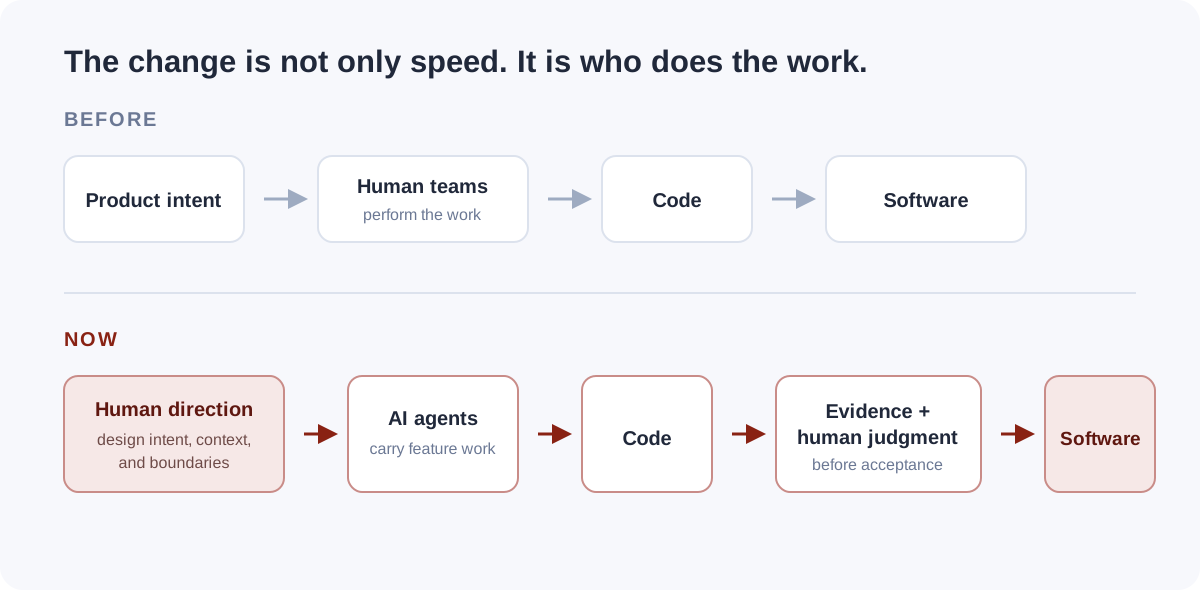
AI changes who does the work
It is tempting to describe AI coding tools as better autocomplete, faster search, or more capable pair programming. Those descriptions aren’t wrong, but they miss something important.
An agent can carry a bounded piece of work much further than a tool that suggests the next line of code. That creates a separation between the person accountable for the product and the system performing much of the implementation.
Developers traditionally accumulated context through the work itself. They learned why the system behaved a certain way, which decisions shaped its architecture, and where a small change might cause trouble. Some of that knowledge was documented; much of it came from experience.
An agent may perform substantial implementation work without carrying that same continuity of context or accountability. It might pass every test without knowing whether those tests represent the outcome we want. It might make a reasonable local decision that conflicts with a broader architectural constraint.
The code can be correct and the outcome can still be wrong.
The challenge, then, is not simply getting code written. It is keeping implementation connected to its purpose and making the result possible to judge.
The Transition to System Builders
This is the shift I am trying to name.
A feature builder asks, “How do I implement this?”
A system builder asks a wider set of questions:
- What outcome are we trying to create?
- What context and tools does the agent need?
- Which decisions can it make independently, and where must it stop?
- How will changes from multiple agents fit together?
- What evidence will show that the result works?
None of this replaces technical skill. It depends on it.
A system builder still needs to understand architecture, data, interfaces, dependencies, tests, and failure modes. The difference is how that knowledge gets applied.
Instead of making every change directly, the developer might design repository boundaries that let agents work independently, build integration tests around important product behavior, or create feedback loops that expose failures early.
Consider a feature requiring changes across an API, a database, and a user interface. An agent may be able to implement all three. Someone still needs to understand how they fit together, which contracts must remain intact, and what successful behavior looks like.
That understanding needs to exist somewhere the agent can use it: in the architecture, tests, documentation, or the plan governing the work.
The goal is not to write better prompts. It is to build an environment in which agents can produce reliable software without constant supervision.
When code gets cheaper, judgment matters more
Faster implementation does not make the work free.
Imagine spending a day directing agents to build a feature, reviewing changes, resolving integration problems, and preparing a release—only to discover that the feature solves the wrong problem.
There was agent usage, human attention, review, rework, operational risk, and the opportunity cost of not building something else.
This is why I think developers need to become more product- and economics-aware, not less technical.
Before implementation begins, we should be able to explain what will change if the feature succeeds, who benefits, and what evidence would make the result convincing. That evidence might be a test, a measurable behavior, a customer outcome, or a demonstration. It depends on the work.
Not every feature needs a financial model, but consequential work deserves a reason to exist. When implementation becomes easier, it also becomes easier to build things that should never have been built.
Choosing the smallest useful intervention—or deciding not to build something at all—becomes an important engineering decision.
A system builder doesn’t ask only, “Can an agent implement this?” They ask, “What outcome would make this investment worthwhile, and how will we know?”
Who is accountable?
If agents perform the work, someone must remain accountable for what gets accepted. I call that person the operator.
The operator is not someone watching an agent type, nor simply a renamed project manager. The operator sets intent, grants bounded authority, judges evidence, and accepts or rejects the outcome.
Within its authorized boundaries, an agent should make ordinary technical decisions without constantly asking permission. But it cannot widen its own authority or declare its work acceptable just because implementation is complete. Those decisions return to the operator.
In a small team, the developer and operator may be the same person. In a larger organization, product and engineering responsibilities may be distributed. The job title matters less than knowing who authorizes the work, who judges the evidence, and who accepts the outcome.
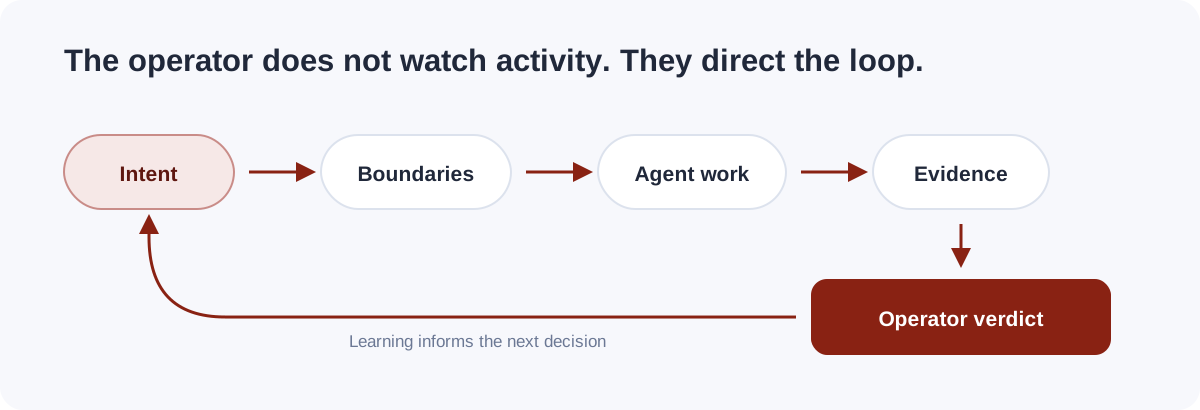
This is also where coordination changes. The answer is not approval at every step; that would turn an agent into expensive autocomplete. The system should allow independent work while making the moments that require human judgment unmistakable.
When scope expands, a new dependency appears, or evidence falls short, the work needs to come back for a decision.
Otherwise, we are left with a familiar sentence: “The agent says it is done.”
Done according to what? A passing test suite and a pull request may be useful evidence. They do not automatically prove that the intended product outcome has been achieved.
When several agents work in parallel, this matters even more. Their output can exceed a person’s ability to review and integrate it. Clear boundaries, integration points, and evidence help prevent a backlog of changes that look complete but are difficult to trust.
The aim is not more process. It is independent execution without surrendering accountability.
The role isn’t dead. It’s changing.
There is a version of this story in which AI makes developers less important because code becomes cheaper.
I see a different possibility.
As implementation becomes easier, the quality of the system around it matters more. Product understanding, architecture, technical boundaries, evaluation, and judgment determine whether all that additional output becomes useful software.
Developers will still write code. Some problems will demand it. But writing every feature by hand will no longer be the only way to contribute engineering value.
The developer who builds a reliable system for agents is not doing less engineering. They are applying their engineering knowledge to a larger problem: creating the conditions in which useful software gets produced.
The developer role isn’t dead. The job is changing from writing every feature to building a system that can deliver the right outcome—and prove it works.